



Industry Insights
Private Label E-Liquid OEM for EU & UK Brands (2026)


If you are planning a private label e-liquid range for the EU or UK in 2026, the calculation just changed. The UK’s new Vaping Products Duty lands on 1 October 2026, and it taxes liquid by volume — not by nicotine strength, brand, or flavour. That single rule reshapes which formats make sense to launch, how big your first order should be, and why locking in a 10,000-bottle commitment before you have validated the market is now a real financial risk.
This guide is for brand founders, importers, and distributors deciding how to source custom e-liquid this year. We cover OEM versus ODM, the TPD and duty compliance baseline, why format strategy now matters more than flavour count, and why starting with a small, controlled production run beats over-committing on day one.
OEM vs ODM E-Liquid: Which Model Fits Your Brand?
These two terms get used interchangeably, but they describe different relationships — and the difference decides who owns your formula.
E-liquid OEM (Original Equipment Manufacturing) means you bring the recipe or flavour brief, and the factory produces it to your specification under your brand. You own the formula. This suits brands that already work with a flavourist or have an established range to reproduce at scale.
E-liquid ODM (Original Design Manufacturing) means the manufacturer supplies recipes from its own tested library, and you select, adjust, and brand them. This is the faster, lower-risk route for brands entering the market or expanding a SKU range quickly.
Most EU and UK brands sourcing from China use a hybrid: pick a base profile from the manufacturer’s library, then co-develop adjustments — sweetness, menthol intensity, VG/PG ratio, nicotine format — into something genuinely ownable. Our e-liquid OEM service is built around exactly this hybrid model: you are never forced to choose from a fixed catalogue.
What Private Label E-Liquid OEM Actually Means
Private label e-liquid OEM — also called white label e-liquid — means a factory manufactures the liquid to your specification and packages it under your own brand, rather than selling you finished stock to resell. You define the flavour, nicotine strength, VG/PG ratio, bottle format, and label artwork. The factory handles formulation, filling, compliance documentation, and packaging. Nothing is held as ready stock; every run is custom to your order. The practical advantage for a new brand is control without infrastructure: you get a branded, compliant product line without operating a mixing facility, sourcing flavour concentrates, or building a TPD notification process from scratch. The trade-off is that your supplier choice becomes a compliance decision, not just a price one — because under the rules below, the factory’s certifications and registrations become your route to market.
The 2026 UK Vaping Products Duty: Why It Decides Your Format
From 1 October 2026, the UK introduces Vaping Products Duty (VPD): a flat excise charge of £2.20 per 10ml of e-liquid (22p per ml), plus VAT, applied at the point of manufacture or import. It applies to every vaping liquid sold in the UK regardless of nicotine strength — including 0mg nicotine-free liquid. Because the duty is charged per millilitre of liquid, format now drives cost more than anything else on your spec sheet. A 10ml bottle carries £2.20 in duty. A 100ml shortfill carries £22. The same flavour, the same nicotine, but a tenfold difference in the duty your customer absorbs. For brand owners, this rewards tight, low-volume formats — prefilled pods and 10ml bottles — and punishes large shortfill SKUs. If you are designing a UK range in 2026, decide your format with the duty in mind before you lock a single flavour.
The duty applies only to the liquid. Devices, coils, empty pods, and batteries are exempt — a point worth holding onto when you plan a prefilled pod kit or a pair it with our hardware.
The duty-stamp and importer rules you cannot ignore
VPD is not just a price line. From 1 October 2026, e-liquid sold in the UK must carry a physical vaping duty stamp on retail packaging, with a six-month sell-through window closing on 1 April 2027. After that date, selling unstamped liquid is a criminal offence, and HMRC can seize stock.
For brands importing overseas-made e-liquid, there is a structural requirement: duty-stamped product must move through HMRC-approved premises, and you will need an approved UK representative under the Vaping Duty Stamps Scheme to order stamps on your behalf. Plan this into your timeline early — approvals are not instant, and a launch held up at customs is far more expensive than the duty itself.
TPD and TRPR: The Compliance Baseline Before You Pick a Flavour
Before format or branding, your liquid has to be legal to sell. For nicotine-containing e-liquid in the EU and UK, the TPD (Tobacco Products Directive) and UK TRPR set non-negotiable limits.
- Maximum nicotine concentration: 20mg/ml
- Maximum bottle size for nicotine liquid: 10ml per unit
- Child-resistant and tamper-evident packaging: mandatory
- Health warning covering at least 30% of the packaging surface
- Ingredient notification before market entry — MHRA for the UK; the national authority of each member state for the EU
- No prohibited additives (vitamins, caffeine, colourants, certain flavourings)
The notification step is where most brands lose time. In the EU, a pan-European launch can require separate notifications across member states; in the UK, notification goes through the MHRA. Each notification typically takes two to three months from submission to clearance. That waiting period is dead time before you can legally take an order.
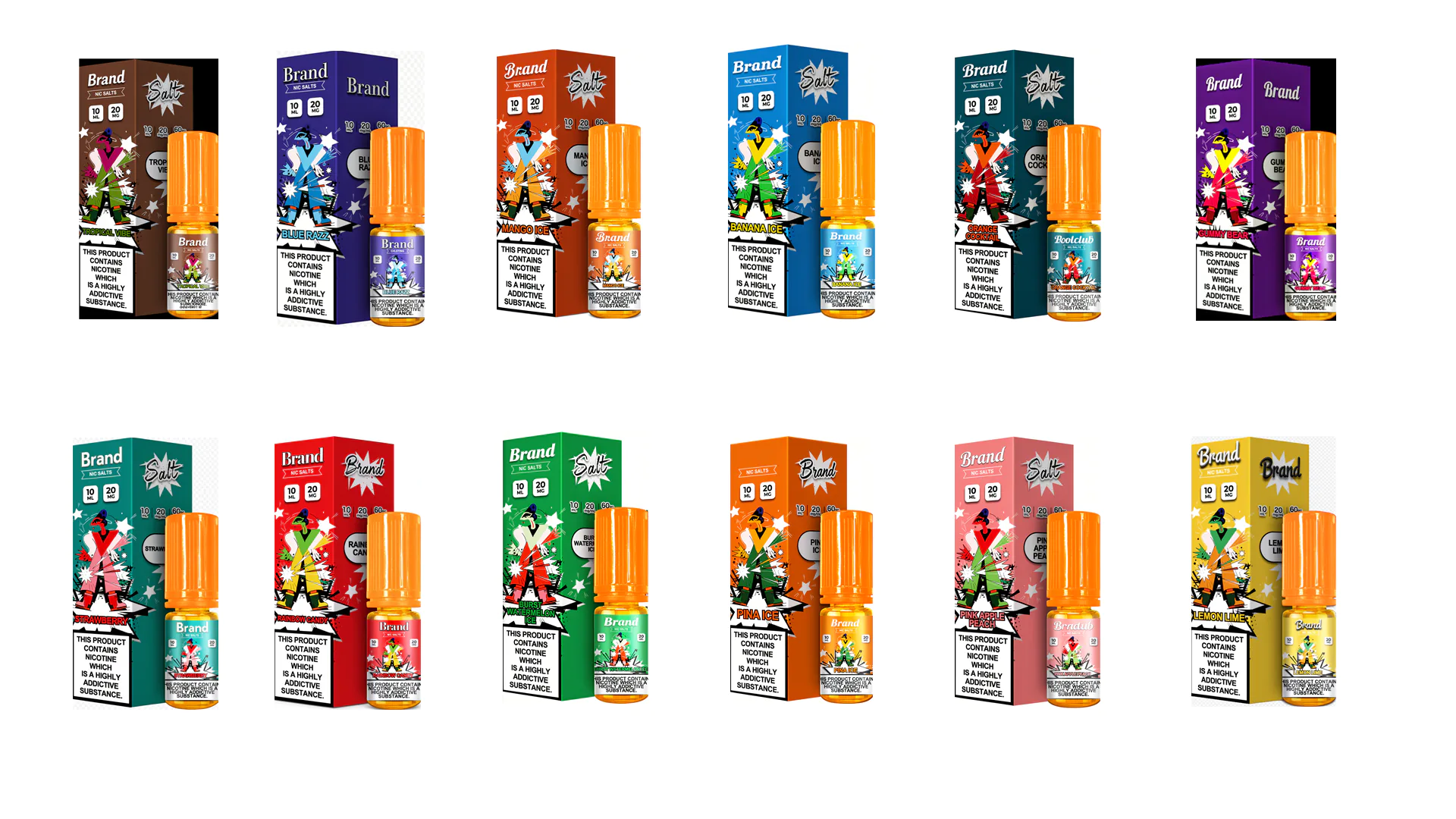
This is where an existing formulation changes your launch calendar. Fifteen of our nicotine salt flavours are in stable production with a complete technical file behind each one: ingredient declaration, emissions data, toxicological information, and third-party test reports.
That file is the input your notification needs. The notification itself belongs to the brand or importer that submits it and does not transfer between companies, so you file your own and the six-month standstill period runs from your filing date. What you skip is the testing and toxicological work a new recipe needs before a filing can even be prepared.
For flavours outside that list, we develop the formulation and coordinate the emissions and toxicological testing your filing will require. For markets outside the EU and UK — the Middle East, Southeast Asia, and the Americas — we formulate to the nicotine limits, volume rules, and labelling requirements of the destination country.
Match the Liquid to the Device: Nicotine Format and VG/PG
A great flavour wicked through the wrong coil tastes muted, burns, or floods. For an OEM project, the liquid spec and the hardware spec are one decision, not two. Two parameters carry most of the weight: nicotine format and VG/PG ratio.
Nicotine salts deliver smoothly at higher strengths (10mg, 20mg) and suit pod systems and MTL devices — the dominant format for recent ex-smokers. Freebase nicotine is smoother at lower strengths (3mg, 6mg) and pairs with sub-ohm, higher-wattage DTL hardware. For a TPD pod brand, nic salt at 10mg and 20mg should be your core.
| VG/PG Ratio | Device Type | Best Matched Hardware |
|---|---|---|
| 50/50 | Pod systems, MTL tanks | A16 2ml Refillable Pod, G2001 2ml E-cig, A31 Replaceable Pod |
| 60/40 VG | Versatile pod / sub-ohm | A52 12ml Replaceable Pod, A46 Open System |
| 70/30 VG | Sub-ohm tanks | A67 DTL High-Power, A38-1 DTL Cloud |
| Max VG (80%+) | High-power sub-ohm | A21 Dual-Mesh, A67 DTL High-Power |
For EU and UK pod brands, 50/50 is the most-requested ratio — strong flavour, efficient filling in ceramic-coil pods, reliable wicking. If you bottle into blank pods for your own filling line, our 2ml ceramic-coil empty pod is available for B2B wholesale and OEM packaging.
Start Small, Then Scale: Low-MOQ Market Testing
One of the most useful questions a new brand can ask an e-liquid OEM factory is, “How small can my first run be?” The answer matters because the cost of guessing wrong on flavour or format is not the production bill — it is a warehouse of liquid your customers did not want, now carrying duty. We accept custom e-liquid orders from 1,000 units. That figure exists for a reason: it lets a brand validate two or three flavours in-market, confirm which format actually sells, and gather real reorder data before committing to volume. For a 2026 UK launch, this is the disciplined play — test a tight set of 10ml prefilled formats, see what moves, then scale the winners. A low first-run threshold turns a launch from a single large bet into a series of smaller, evidence-based decisions, which is exactly how durable brands are built in a newly taxed market.
Volume still earns better economics as you grow — that is true at any factory. The point is that you do not have to buy at volume to start. You buy small, learn fast, and scale into demand you have actually measured.
One Partner for Liquid and Hardware
Most European e-liquid OEM providers only make liquid. Launch a pod kit through them and you are running two supplier relationships: one for the device, one for the liquid — two timelines, two quality standards, two shipping lanes, and two points of failure before launch.
Manufacturing both within one program changes the workflow. Coil and wicking can be specified against your liquid’s VG/PG ratio at the design stage, not patched after you receive hardware that wicks badly. Flavour testing happens on your actual device. Compliance documentation for hardware and liquid runs as one coordinated submission. And tooling, sampling, and liquid sign-off run in parallel, compressing your overall timeline. For a brand launching a prefilled pod system with a signature liquid range, that single accountable line matters more than any single line-item saving.
Your 2026 E-Liquid OEM Sourcing Checklist
- Confirm your destination market first. EU/UK means 10ml and 20mg caps; Middle East, SEA, and the Americas allow larger formats and higher strengths.
- Choose format with the UK duty in mind. Prefilled pods and 10ml bottles absorb VPD far better than large shortfills.
- Ask whether flavours already have a complete technical file (ingredient, emissions, and toxicological data). Existing documentation removes the testing and review stage that comes before a notification can be filed.
- Sort your UK duty-stamp route early. If you import, line up an approved UK representative and HMRC-approved premises before production.
- Match nicotine format and VG/PG to your device at the spec stage, not after hardware arrives.
- Start with a small validation run. Test two or three flavours and formats before scaling into measured demand.
- Get your NDA and formula ownership in writing. A custom recipe should be yours — confirm it in the contract.
- Request documentation up front: MSDS, COA, ingredient lists, and TPD/TRPR notification files.
Frequently Asked Questions
What is the difference between OEM, private label, and white label e-liquid?
In practice they describe the same arrangement: a factory produces e-liquid to your specification and packages it under your brand. “OEM” emphasises building to your spec; “private label” and “white label” emphasise selling under your own name. With us, all three mean a fully custom product — flavour, format, strength, and branding are your choice.
What is the minimum order for private label e-liquid?
We accept custom e-liquid orders from 1,000 units, which lets a new brand validate flavours and formats in-market before scaling. Exact terms depend on bottle format and customisation level — contact us with your spec and target market for current details.
Does the 2026 UK vape tax apply to imported e-liquid?
Yes. Vaping Products Duty applies to e-liquid manufactured in or imported into the UK from 1 October 2026, at £2.20 per 10ml plus VAT, regardless of nicotine strength. Imported liquid must carry a vaping duty stamp and move through HMRC-approved premises, and importers need an approved UK representative under the Vaping Duty Stamps Scheme.
Do existing formulations really launch faster?
Yes, but not for the reason most people assume. A notification belongs to the brand that submits it and does not transfer, so you file your own either way and the six-month standstill period runs from your filing date.
What you save is the stage before the filing. A new recipe needs emissions testing, toxicological review, and stability work before anyone can submit anything, and that stage is usually longer than the notification itself. Fifteen of our formulations already carry that complete data set.
Can I order e-liquid and hardware from the same factory?
Yes. We manufacture both, so you can develop devices and liquids with one partner and keep branding, specifications, and timelines aligned. For prefilled devices, we coordinate filling so your custom liquid and custom hardware ship as one finished product.
Should a pod brand use nicotine salt or freebase?
Nicotine salt. It delivers smoothly at the 10mg and 20mg strengths that suit pod systems and recent ex-smokers, which is why it dominates the TPD pod category. Freebase at 3mg–6mg is the right choice for sub-ohm DTL hardware instead.
Ready to source 2ml TPD format vape hardware, empty pods, or start your OEM/ODM project?
Contact our team directly:
- WhatsApp: +86-134-1240-5657 (fastest response)
- Email: [email protected]
- Website: www.gg-vape.com
We respond within 24 hours. Sample orders welcome.
🔗 Related Reading
- EU & UK Vape Compliance 2026: TPD, EPR and OEM Guide
- Which 2ml Vape Format Should Your EU Brand Source?
- Refillable Pod System Manufacturer: 2026 OEM/ODM Sourcing Guide
- Empty Vape Pods Wholesale: OEM Sourcing Guide
For B2B trade enquiries only. Adults 18+ only.